In advance of her upcoming mini course, Kidlit Self-Publishing 101: Strategies for Indie Publishing Success (January 26 and 28) author, editor and indie publisher Darcy Pattison is sharing some tips here for publishing and submitting award-winning books. Thanks, Darcy!
When you self-publish children’s books, many assume poor quality stories and books, and a limited local audience. Nothing could be farther from the truth.
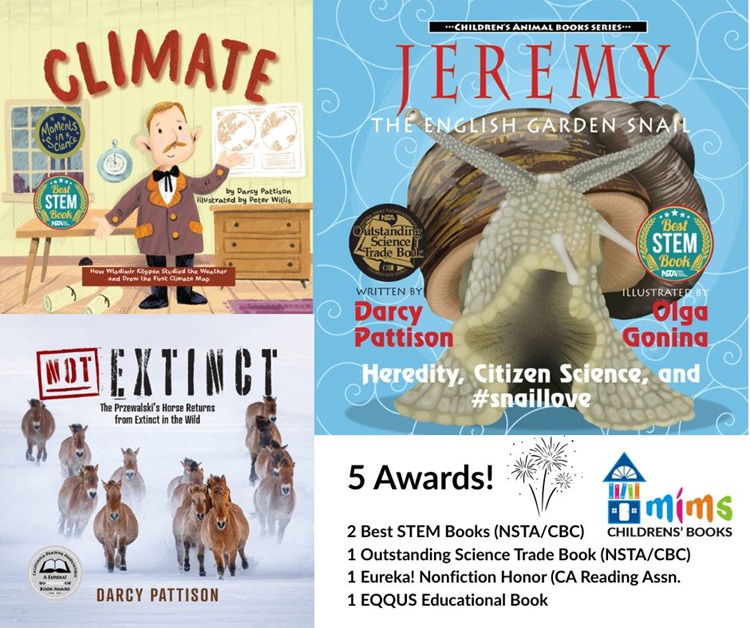
In 2025, my books have found recognition from respected awards and will be sold in national and international markets:
- NOT EXTINCT: The Przewalski’s Horse Returns from Extinct in the Wild was named a 2025 Eureka Nonfiction Honor Book, California Reading Association and a 2025 EQUUS Film and Art Fest, Winnie Award for Best Children’s Educational Book.
- Jeremy, the English Garden Snail: Heredity, Citizen Science, and #snaillove, Book 7 of the Children’s Animal Book Series was named a 2026 Outstanding Science Trade Book- NSTA/CBC and a 2026 Best STEM Book – NSTA/CBC
- CLIMATE: How Wladimir Köppen Studied Weather and Drew the First Climate Map, Book 10, Moments in Science Series was named a 2026 Best STEM Book – NSTA/CBC.
Children’s librarians and teachers rely on reviews to help pinpoint books for their libraries and classrooms. While I submit all my books for reviews, the major review journals are increasingly overwhelmed by the number of submissions. Kirkus is reported to charge a fee for a review from everyone except the big five publishers; paying for a review guarantees that they will look at the book, although they maintain the right to review as they see fit. School Library Journal and Booklist Online will sometimes review my books, but there’s never a guarantee. When reviews aren’t forthcoming, I turn to awards as a way to help my stories stand out in today’s crowded market.
Submitting for Book Awards
The process for submitting to book awards is simple. You identify a likely award for your title, ask for a list of judges or submission criteria, and then mail copies of the book to the judges.
Quickly, I must say that there are many bogus awards which solicit submission for a substantial fee and then award something to virtually every entry. Avoid such scam awards!
Instead, I look for awards from teacher’s groups such as the National Science Teaching Association (NSTA), which offers the Best STEM Books and the Outstanding Science Trade Book awards. For these awards, it’s helpful for your publishing company to join the Children’s Book Council (CBC) as an associate member for a reduction in submission fees. The CBC also helps administer awards from the social studies teachers, the Notable Children’s Books in Social Studies, and the math teachers, the Mathical Awards.
Look for awards from recognized institutions such as Bank Street College, the American Library Association (ALA), or the Independent Bookseller’s Association (IBPA). See a list of recommended awards here.
Also check out the Alliance of Independent Authors Book Awards and Contest Ratings.
Be sure to read the award’s information on the type of book, look at previous lists of winners to assess if your book fits the award, and follow all the submission guidelines.
Does a Book Award Help Marketing?
Part of the decision to enter your book for an award should be a consideration of whether the award will help in marketing the book. Such an award answers a major question for a reader: is this a good book? When an award committee judges it to be worthy of the award, that carries weight in many circles.
For example, two of my 2025 books won three science teacher’s awards: two BEST STEM books and one Outstanding Science Trade Book. When I talk to science teachers, administrators at the local, state, national, or international level, I always mention the awards. My previous title CLANG!, a story about a sound scientist who presented science experiments to Napoleon’s court, was considered as a title for the Little Passports science/STEM box. Because it was named an Outstanding Science Trade Book, Little Passports decided to include the book in a science/STEM box, which meant thousands of book sales. CLANG! beat out other options because of the award.
Overall, the awards add credibility to your publishing company and to your own credibility as an author. As awards accrue, they build name recognition and bring back repeat customers in search of the next great book.
But even when the book doesn’t win an award, submitting to awards is a win-win. The award judges are opinion makers in their field and thus need to have a copy of my book. I know that sales come when a judge recommends a book for a certain topic or type of reader. Submitting to awards is a crucial part of building my publishing program.